
Seismic waves, created by some mechanical means (naturally or artificially), travel through the ground at a rate determined by the density of the medium. Different rock and sediment types vary in their density and elastic properties. When a wave encounters a layer with a different density, some of the wave energy will be reflected at the discontinuity, whilst some will be refracted and continue travelling in a different direction. Thus, differences in the make up of the Earth's interior can have the effect that waves originating from a fixed point arrive at an observer at different times. Geophysicists can create their own, harmless forms of seismic activity and measure the responses to these disturbances using a wide variety of surveys on land and sea, thereby to deduce the properties of materials.
Differences in the density (amongst other factors) of the deposits underground create a range of responses to a controlled source of energy (such as a seismic vibrator) which can be measured using a geophone (on land) or hydrophone (underwater). By analyzing the travel times from the source to the receivers and the velocity of the waves, it is possible to create a 2D profile or 3D map of the underlying strata from the responses received.
There are three major types of seismic surveys: refraction, reflection, and surface-wave. Each technique addresses a different type of wave.
We offer refraction, reflection and surface-wave surveys.
Reflection seismology measures the time taken for seismic waves to travel from a source, reflect off an interface and be detected by an array of receivers.
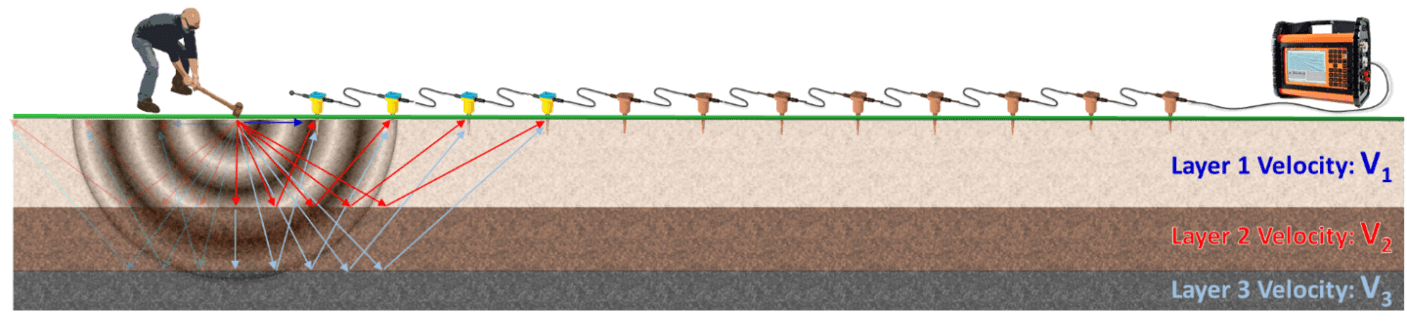
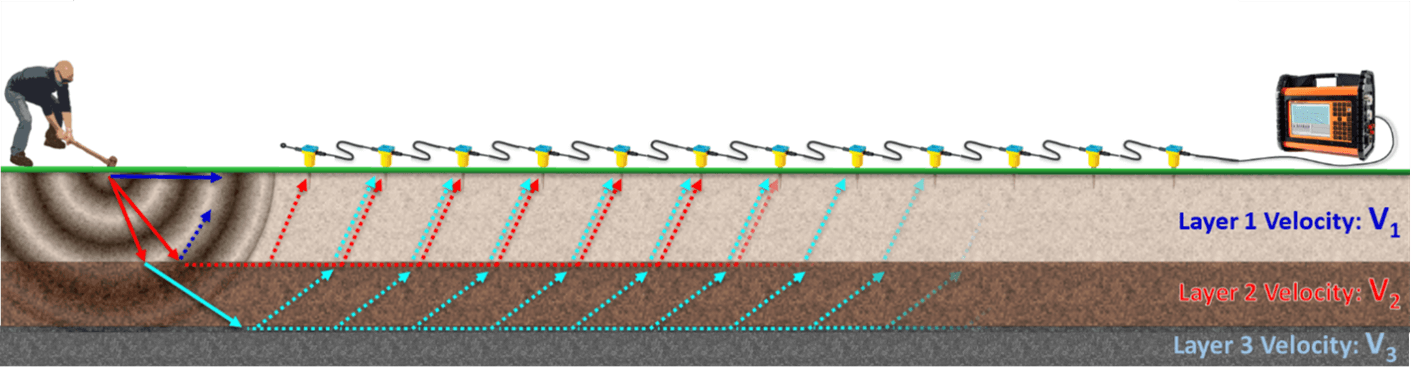
Refraction seismology measures the time taken for seismic waves to travel from a source to several receivers after being redirected by one or more changes of medium.
The properties of different materials can affect the propagation of a wave as a result of its travelling at different speeds at different points along the wave front. Under certain conditions, seismic waves undergoes what is known as critical refraction. A critically refracted seismic wave travels along acoustic interfaces and generates new waves that can be detected at the surface. Refraction seismology measures the time a pulse of seismic energy takes to travel from a source point to several receivers after being redirected by one or more subsurface interfaces.
Illustrations: guidelinegeo.com
Estimating rippability prior to excavation
Mapping depth to bedrock/bedrock topography
Mapping depth to ground water
Measuring the thickness of the weathering zone
Calculation of elastic moduli/assessment of rock quality
Mapping thickness of landslides
Identification and mapping of faults
Surveys can be conducted on a variety of scales, to suit the task, such as (for example) identifying potential sites for underground carbon capture and storage.
Contact us to discuss how seismic surveys can support your project's specific needs. We're here to help you choose the right geophysical approach for optimal results.
Get in Touch